Entrepreneur Legal UK · Insight
Contractor vs Employee in the UK: Employment Status, Tax and Worker Rights
By Gabriel C. Mbanefo — Solicitor of the Senior Courts of England and Wales; Director & CEO, Entrepreneur Legal UK.
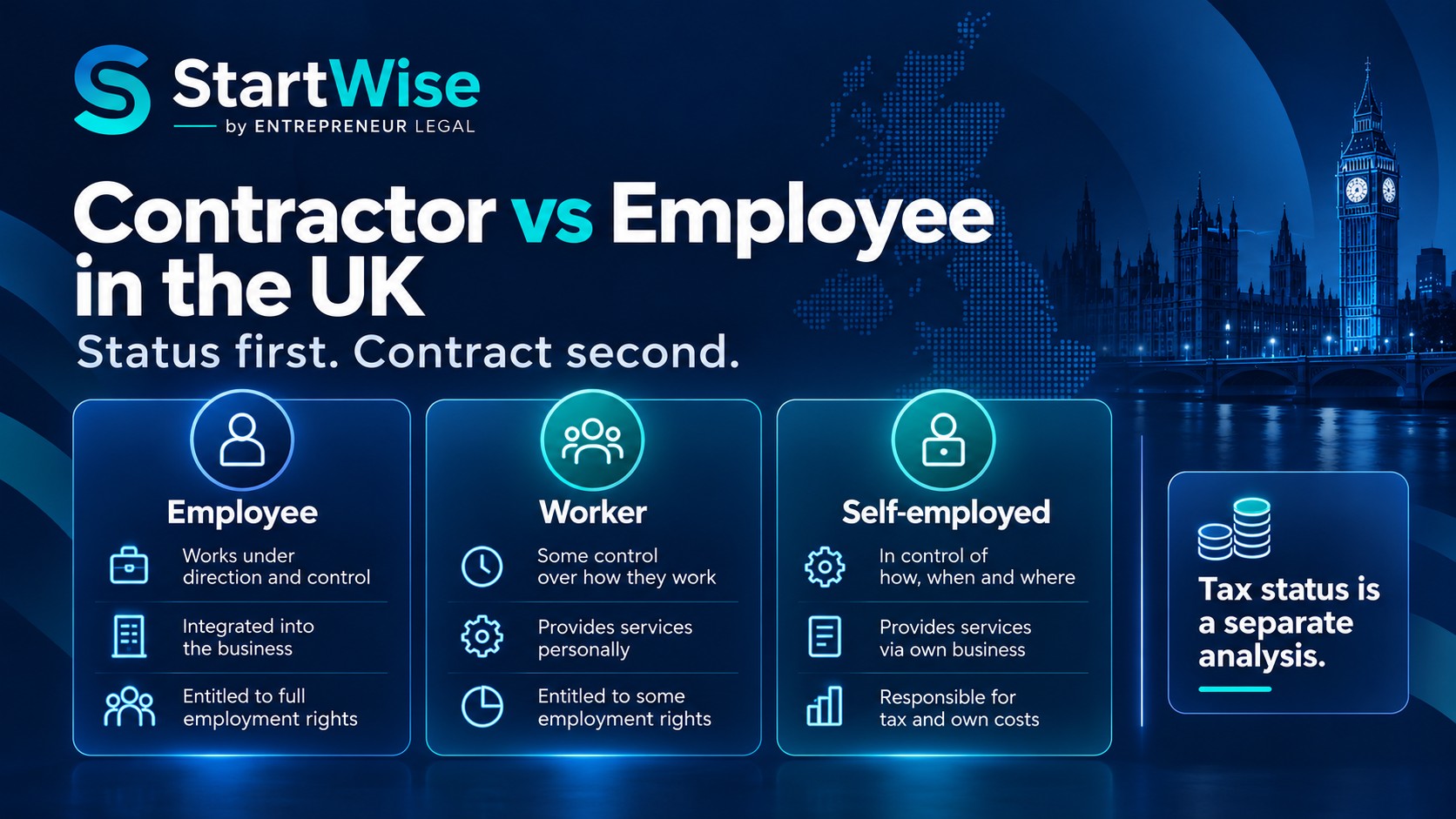
At a glance: employee, worker and self-employed
| Status | Typical indicators | Rights / implications | Founder watch-out |
|---|---|---|---|
| Employee | Regular work, significant employer control, personal service, integration and mutual obligations. | Broadest employment-rights package; PAYE/tax obligations may apply depending on tax status. | Calling the person a contractor does not remove employee status if the facts point the other way. |
| Worker | Personal service and limited independence, without necessarily the full employee relationship. | Core rights can include minimum wage, paid holiday, payslips and whistleblowing protections. | “Not employee” does not automatically mean “self-employed”. |
| Self-employed | Runs own business, has meaningful control, may serve multiple clients and bears business risk. | Generally fewer employment rights; contractual and other statutory protections may still apply; tax is handled separately. | Invoicing and a contractor label are evidence, not a complete legal test. |
The founder scenario that looks like a contractor-agreement problem
A startup hires a freelance developer directly as an individual. The paperwork says “independent contractor”. Twelve months later, the developer works Monday to Friday on the startup’s systems, reports to the CTO, cannot send a substitute, needs approval for time off and has no meaningful clients elsewhere.
The document title did not settle the status. The working relationship created the risk. That is why classification should be assessed before the startup relies on contractor drafting.
Employment rights and tax status are different questions
GOV.UK and Acas both distinguish employment status for employment-rights purposes from status for tax purposes. A person treated as self-employed for tax purposes is not automatically self-employed for employment law, and vice versa. Employers should therefore avoid using a single label as a universal answer.
For tax, HMRC provides the Check Employment Status for Tax tool, but the result addresses tax status rather than every employment-rights question. Off-payroll working rules can also be relevant where services are supplied through an intermediary.
What points towards employee status?
No single factor answers every case, but current Acas guidance points to features such as regular required work, expectation of continuing work, inability to send someone else, employer control over how, when and where work is done, employer-provided equipment and application of internal procedures.
The practical founder question is how the relationship works in reality: control, personal service, mutual obligations, integration and business independence matter more than whether the person sends invoices.
What is a “worker” and why does it matter?
Employment law in Great Britain also recognises a worker category with fewer rights than an employee but more rights than a person genuinely in business on their own account. Current Acas guidance describes workers as often providing personal service with limited obligation for regular hours while not running a business whose customer is the hiring organisation.
Workers can have important statutory protections such as minimum wage and paid holiday. Treating everyone outside PAYE as self-employed can therefore create exposure even where full employee status is not established.
What points towards genuine self-employment?
For practical purposes, indicators that someone is genuinely in business on their own account can include meaningful control over how and when the work is performed, the ability to work for different clients, quoting for work, invoicing, responsibility for business risk and a genuine ability to provide a substitute where the arrangement supports that right.
Founders should look at reality. A substitution clause that no one could realistically use, or a theoretical freedom contradicted by day-to-day control, may carry less weight than the actual practice.
Why the contract still matters
The fact that the contract does not decide status does not make it irrelevant. A well-drafted agreement should accurately record the intended commercial relationship, including services, control, substitution where genuine, fees, expenses, equipment, IP, confidentiality and termination.
The mistake is using contractual wording to describe freedoms that do not exist in practice. The Supreme Court decisions in Autoclenz Ltd v Belcher and Uber BV v Aslam reinforce that statutory employment-status questions are not settled simply by a written label or by terms that do not reflect the real relationship. The agreement should match actual working practices and be revisited if those practices change.
Misclassification can create more than a contract problem
GOV.UK warns that getting status wrong can lead to unpaid tax and penalties or loss of rights and benefits. Employment-rights claims can also arise. The practical exposure depends on the facts, the period involved and the legal route, which is why ambiguous cases should be assessed early.
For most Employment Tribunal claims where the time limit starts on or after 1 October 2026, the usual time limit increases to six months minus one day. Claim-specific rules and Acas Early Conciliation can affect the calculation, so limitation should be checked promptly if a dispute arises.
Common classification mistakes and what they can lead to
- Starting with the preferred label instead of the actual working model can leave the business exposed if the facts point to a different status.
- Treating a PAYE, CEST or other tax-status outcome as the answer for employment rights can produce the wrong conclusion because the two analyses are separate.
- Using substitution, control or independence clauses that do not reflect reality may give those clauses less weight when status is tested.
- Failing to revisit status when the relationship changes can turn a once-routine contractor arrangement into a higher-risk classification issue.
A founder decision framework
- Start with the actual day-to-day working model, not the label you would prefer to use.
- Ask who controls how, when and where the work is done.
- Check whether personal service is required and whether substitution is real.
- Look at the person’s business independence, other clients, financial risk and integration into your organisation.
- Assess employment-rights status and tax status separately.
- Only after classification is reasonably clear should you select an employment or contractor document.
- Revisit the classification if the relationship changes over time.
Where legal support and StartWise® fit
If status is uncertain, book a legal consultation before selecting an employment or contractor agreement. This is particularly important where the person is integrated into the core team, the relationship is long-term or highly controlled, an intermediary or personal service company is involved, or the financial consequences of getting status wrong are material. Book a consultation.
Once status is reasonably clear and the person is genuinely being engaged as an independent contractor in a routine arrangement, StartWise® Drafting currently includes an Independent Contractor Agreement. The guided questions can help the founder record the agreed commercial terms and generate a tailored first draft. Additionally the Drafting Notes can highlight assumptions, points to confirm, practical completion issues or circumstances where lawyer review may be appropriate. Explore StartWise®.
FAQs
Can someone be a contractor and still have worker rights?
Potentially, yes. GOV.UK notes that a contractor can be self-employed, have worker status, or in some agency arrangements have employee status. The label “contractor” is not a complete employment-status category.
Does a contractor agreement make someone self-employed?
No. The agreement is relevant evidence, but legal status depends on the overall relationship and what happens in practice.
Is HMRC’s CEST result the same as employment-law status?
No. CEST is a tax-status tool. Employment-rights status is a separate legal analysis.
What if the contractor works through their own limited company?
That changes the analysis. For employment-rights purposes, the contractual chain and whether the end client is a client or customer of the contractor’s business can matter. Separately, HMRC’s off-payroll working rules may apply where an individual supplies services through an intermediary and would have been an employee for tax purposes if engaged directly; responsibility for the status determination depends partly on the type and size of the client. Get advice where the distinction is material.
Can a person be self-employed for tax but a worker for rights?
The systems are separate, so different outcomes can arise. That is why founders should check both where the distinction matters.
When should a founder get advice?
Get advice where the person works like part of the core team, the relationship is long-term or highly controlled, an intermediary/personal service company is involved, status has changed over time, or the financial consequences of getting the classification wrong are material.
Key legal and official sources
- Employment Rights Act 1996, section 230 — employee and worker definitions.
- Autoclenz Ltd v Belcher [2011] UKSC 41.
- Uber BV v Aslam [2021] UKSC 5.
- HMRC employment-status and off-payroll working guidance: Check Employment Status for Tax and Off-payroll working for clients.
- Acas, Employment tribunal time limits, including the 1 October 2026 change.
- Northern Ireland employment-status guidance.
Related resources
- Hiring Employees and Contractors (UK).
- Contractor Agreement UK: What It Should Cover.
- Legal consultation / contact Entrepreneur Legal UK.
- StartWise® UK Access.
- Entrepreneur Legal UK profile / approved biography source.
Author / legal review / update information
Author: Gabriel C. Mbanefo — Solicitor of the Senior Courts of England and Wales; Director & CEO, Entrepreneur Legal UK. Author profile: https://uk.entrep.legal/about/
Legal and product review: Gabriel C. Mbanefo. Last substantive legal/source review: 18 September 2026.
Publication version: 13 October 2026. This version incorporates current primary law and official guidance checked on 18 September 2026, including officially scheduled changes taking effect by 13 October 2026.
Choose the right next step
Classify first. Document second.
If employment status is uncertain, obtain legal advice before choosing the document. Once the relationship is reasonably clear and genuinely independent, explore the current guided UK documents through StartWise.