Entrepreneur Legal UK · Insight
Contractor Agreement UK: What It Should Cover
By Gabriel C. Mbanefo — Solicitor of the Senior Courts of England and Wales; Director & CEO, Entrepreneur Legal UK.
At a glance: is a contractor agreement the right next step?
| Question | Practical answer |
|---|---|
| Who is this for? | Businesses engaging a genuinely independent contractor, consultant or freelancer rather than filling an employee or worker role. |
| When does it arise? | After the intended working model and classification have been considered, ideally before substantial services begin or when formalising an existing independent relationship. |
| Is a contractor agreement legally required? | There is no single statutory form of “contractor agreement” generally required for ordinary engagements. A written agreement is usually advisable, and particular written terms or contracts may be legally required for matters such as copyright assignment or processor arrangements. |
| What should be checked first? | Employment-rights status, tax/off-payroll position where relevant, the real control/personal-service model, any intermediary or personal service company, and cross-border or territorial issues. |
| Routine drafting route | Where the relationship is genuinely independent, reasonably standard and commercially agreed, use the StartWise Independent Contractor Agreement. |
| Get advice first when | Status is unclear; IR35/off-payroll or an intermediary is involved; the matter is cross-border, regulated, high-value or disputed; or material IP, data or liability exposure needs bespoke analysis. |
| Agreement area | What it should answer | Why it matters |
|---|---|---|
| Status and relationship | What independent relationship is intended, and does practice match it? | Labels do not override the real working arrangement. |
| Services and deliverables | What work, milestones, dependencies and acceptance apply? | Prevents “contractor” from becoming an undefined ongoing role. |
| Control and substitution | Who decides how/when/where work is done, and can a substitute genuinely be used? | Relevant to operating model and status evidence. |
| Fees, expenses and tax | Rate/fixed fee, invoicing, VAT, expenses and tax responsibility. | Creates payment mechanics without pretending tax status is settled by the clause. |
| IP and confidentiality | Who owns created work and what information may be used/disclosed? | Payment to a freelancer does not automatically transfer copyright. |
| Liability and insurance | Risk allocation, caps, indemnities and cover where appropriate. | Should reflect the actual project and legal limits. |
| Term and termination | Duration, notice, breach, handover and surviving obligations. | Allows a clean exit and protects continuity. |
Founder scenario: “freelance developer” can describe two very different relationships
A startup hires a developer for a three-month MVP build. They quote a project fee, use their own tools, choose how to deliver the work, serve other clients and can provide a suitably qualified substitute subject to reasonable safeguards. That looks different from a developer working indefinitely, Monday to Friday, under the CTO’s day-to-day direction, using company equipment and needing permission for time off.
Both arrangements might be called “contractor” in an email. The contract should describe the reality, not create a paper label that conflicts with it.
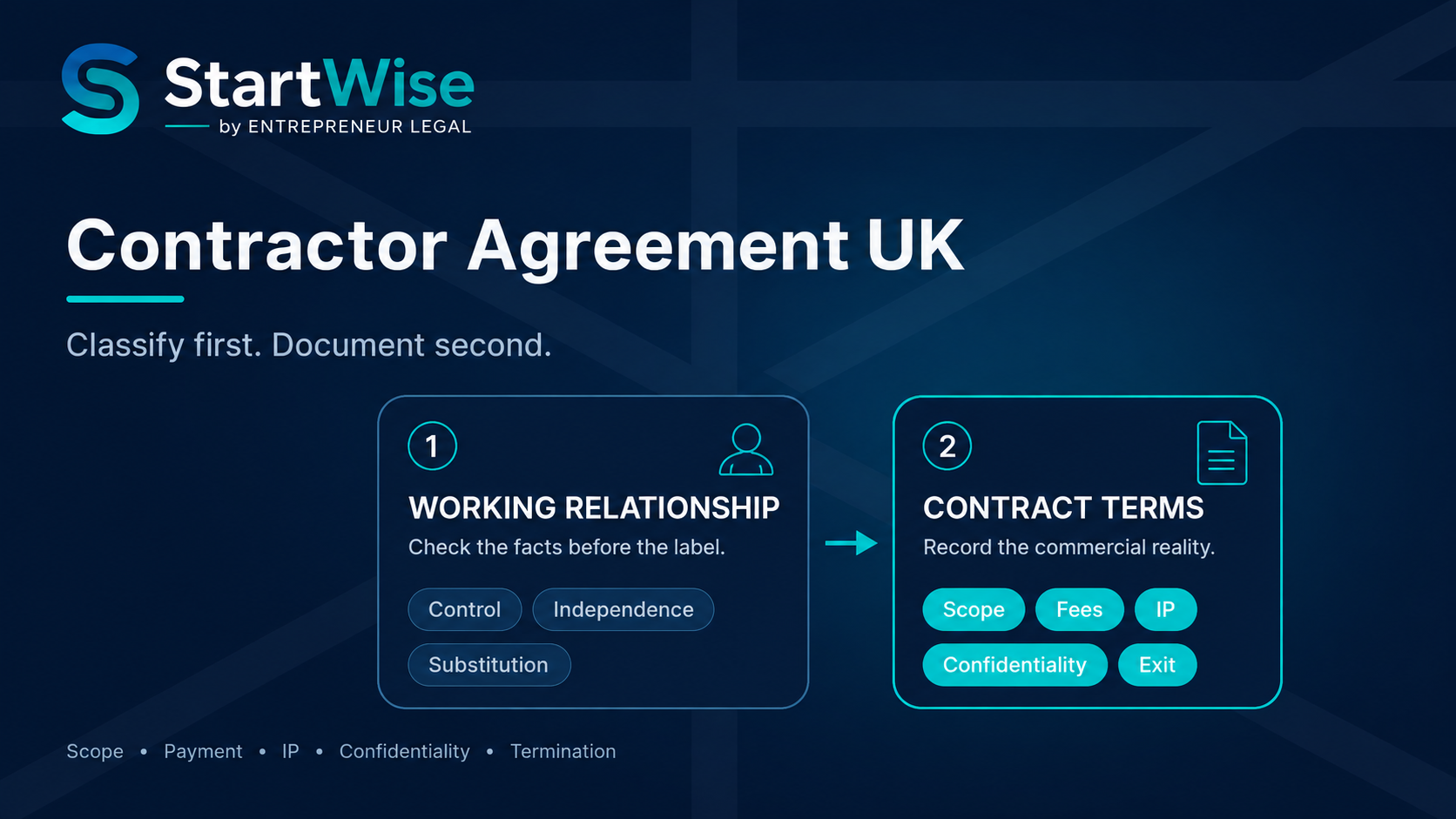
1. Start with employment status and tax as separate questions
For Great Britain employment-rights purposes, the Employment Rights Act 1996 defines employee and worker status. Acas also uses self-employment as a practical category, while noting that self-employed status itself is not defined in employment law. Tax status is a separate analysis. GOV.UK similarly warns that a person described as a contractor may, depending on the relationship, be self-employed, a worker or an employee.
HMRC’s CEST tool addresses tax and National Insurance status. Its current guidance says users should consider the true agreement and working practices, not just standard terms designed to produce a preferred outcome. Northern Ireland has a separate employment-law regime and official status guidance. Where the relationship is borderline, classification advice should come before document generation.
For wider status and hiring guidance, see Hiring Employees and Contractors.
2. Define the service as a business outcome
A contractor agreement should identify services, deliverables, milestones, client dependencies, acceptance criteria and excluded work. A project-based statement of work can be useful where the commercial relationship continues across several assignments.
Avoid drafting the scope like an employee job description if that is not how the relationship is meant to work. The practical test is whether the document describes an independent service provider delivering an agreed result rather than simply filling a role inside the organisation.
3. Record control and substitution honestly
Control and personal service are relevant factors in status analysis. If the contractor genuinely controls method, sequence or working location within agreed project constraints, say so accurately. If a substitution right exists, describe the real conditions around it.
A theoretical substitution clause that no one could use, or language stating independence while managers exercise employee-like control, can create a mismatch between document and practice.
4. Make payment and expenses operational
State the fee model, invoicing trigger, VAT treatment where relevant, approved expenses, payment date and consequences of disputed or late invoices. If payment depends on milestones or acceptance, define those events clearly.
Do not use the contract to give a definitive tax conclusion if the tax position has not actually been assessed.
5. Deal expressly with intellectual property
Under the Copyright, Designs and Patents Act 1988, the author is generally the first owner of copyright subject to statutory exceptions, including the employee exception. A commissioned freelancer therefore does not normally transfer copyright merely by being paid. If the client is to own copyright, an assignment must satisfy the statutory writing and signature requirements under section 90. A contractor agreement should decide who owns project-created IP, distinguish the contractor’s pre-existing material and deal with any licence the contractor needs to retain or the client needs to receive.
Source code, design systems, photos, written content, brand assets and other third-party components may also have separate licence conditions. A broad ownership sentence cannot transfer rights the contractor does not own.
6. Confidentiality, data and security may need more than one clause
Confidentiality can restrict how non-public information is used and disclosed. If the contractor acts as a processor of personal data on the company’s behalf, UK GDPR Article 28 requires the processing to be governed by a binding controller-processor contract or other legal act containing specified terms. Those terms can sit in the contractor agreement or in a separate data-processing agreement. If the contractor acts as an independent controller instead, different requirements apply. Security obligations should reflect access to systems, credentials, repositories and customer information.
7. Allocate liability around the real project
Consider responsibility for third-party claims, IP infringement, data/security failures, property damage, delay and re-performance. For contracts governed by English law, exclusions and limitations are not automatically enforceable merely because they appear in the agreement: the Unfair Contract Terms Act 1977 can restrict certain negligence exclusions and standard-term limitations, including through its reasonableness test. Liability for death or personal injury caused by negligence cannot be excluded. Any cap or indemnity should therefore reflect the project and be legally reviewed where the exposure is material.
8. Termination should include handover
Set notice, breach and termination rights, then deal with what happens next: outstanding fees, unfinished work, return of information/equipment, access revocation, transfer of work product and survival of IP/confidentiality obligations.
Before-you-draft contractor checklist
- Map the real day-to-day working model.
- Check employment-rights status and tax status separately where necessary.
- Agree scope, milestones, dependencies and acceptance.
- Decide control and any genuine substitution arrangement.
- Agree fees, VAT, expenses and invoice mechanics.
- Identify created IP and pre-existing/third-party material.
- Map confidential information, system access and data processing.
- Set liability, insurance, term, termination and handover.
Common mistakes and consequences
| Mistake | Practical consequence |
|---|---|
| Using “independent contractor” as the classification analysis | The working reality may still support employee or worker status. |
| Copying an employee-style job description | The paper can conflict with the intended independent model. |
| No IP transfer or licence analysis | The company may pay for work without obtaining the ownership/use rights it expects. |
| No change/acceptance mechanics | Project scope and payment disputes become harder to resolve. |
| No exit/handover process | Credentials, code, files and unfinished work can become operational risk. |
How StartWise™ Drafting fits
StartWise currently includes an Independent Contractor Agreement. For a reasonably standard relationship that has already been classified and commercially agreed, the user can answer guided questions, generate a tailored first draft and review any Drafting Notes.
Drafting Notes can flag assumptions and completion points. They are not an employment-status or tax determination. Where classification, IR35/off-payroll, cross-border tax or a disputed status issue is material, get advice first.
Frequently asked questions
Does a contractor agreement make someone self-employed?
No. The agreement is relevant evidence, but employment-rights and tax status depend on the real relationship and applicable legal tests.
What is the difference between employee, worker and self-employed?
For Great Britain employment-rights purposes, employee and worker are statutory categories with different rights. A genuinely independent person may fall outside those categories and be self-employed; Acas notes that self-employed status itself is not defined in employment law. Tax status is separate, and Northern Ireland has its own employment-law regime.
Should the agreement include substitution?
Only if substitution is genuinely part of the commercial arrangement. A clause should describe reality rather than be inserted simply to obtain a desired status label.
Who owns IP created by a freelancer?
Copyright will usually remain with the creator unless the ownership position is changed by contract. The agreement should deal expressly with assignment or licensing.
When should I get legal advice before using a contractor agreement?
Where the person works like part of the core team, status is unclear, an intermediary/personal service company is involved, the arrangement is cross-border, or the financial consequences of misclassification are material.
Sources and related Entrepreneur Legal resources
- Primary authority: Employment Rights Act 1996, s.230 (employee and worker definitions).
- Primary authority: Uber BV v Aslam [2021] UKSC 5 (status determined under the statutory framework and by the reality of the relationship, not contractual labels alone).
- Primary authority: Copyright, Designs and Patents Act 1988, s.11 (first ownership).
- Primary authority: Copyright, Designs and Patents Act 1988, s.90 (copyright assignments).
- Primary authority: UK GDPR, Article 28 (processor contracts).
- Primary authority: Unfair Contract Terms Act 1977, ss.2, 3 and 11 (negligence exclusions, standard terms and reasonableness).
- Official guidance: Acas, Employment status.
- Official guidance: Acas, Self-employment.
- Official guidance: GOV.UK, Self-employed and contractor.
- Official guidance: HMRC Employment Status Manual / CEST.
- Official guidance: nidirect, Employment status (Northern Ireland).
- Official guidance: UK IPO IP Healthcheck / copyright ownership.
- Related Entrepreneur Legal resource: Hiring Employees and Contractors.
- Related Entrepreneur Legal resource: What Legal Documents Does a UK Startup Need? (2026 Guide).
- Author profile: Gabriel Mbanefo / Entrepreneur Legal UK.
Disclaimer
StartWise™ Drafting is not legal advice, lawyer review, legal approval or legal sign-off. Creating an account, purchasing drafting credits or generating a document does not by itself create a lawyer-client relationship. Entrepreneur Legal UK is the trading name of Entrepreneur Legal Ltd. Entrepreneur Legal Ltd is not regulated by the Solicitors Regulation Authority and does not carry on reserved legal activities.
Choose the right next step
Draft through StartWise. Review for less.
Explore the current guided UK workflows, or contact Entrepreneur Legal UK where your matter requires review, consultation or bespoke support.