Entrepreneur Legal UK · Insight
Who Owns Work Created by a Freelancer in the UK?
By Gabriel C. Mbanefo — Solicitor of the Senior Courts of England and Wales; Director & CEO, Entrepreneur Legal UK.
At a glance: what changes the ownership answer?
| Question | Default / legal point | What the startup should evidence |
|---|---|---|
| Was the creator an employee? | An employee who creates qualifying copyright work in the course of employment is generally not in the same position as an independent freelancer. | Employment status and role; creation in course of employment; relevant contract. |
| Was the work commissioned from a freelancer? | Commissioning and payment do not automatically transfer copyright. | Signed contract or assignment addressing the relevant rights. |
| Is ownership or only permission needed? | A licence can permit use without transferring ownership. | Licence scope: media, territory, duration, modification, sublicensing and commercial use. |
| Does the creator use background or third-party IP? | A freelancer cannot assign rights they do not own. | Background-IP schedule, third-party licence disclosures and open-source review where relevant. |
| Is the work a design, patentable invention or other registrable right? | Different ownership/formality rules may apply. | Right-specific analysis and any required registry or assignment steps. |
Why paying for the work is not the ownership test
The commercial intuition is understandable: the company writes the brief, pays the fee and receives the files. Copyright law asks different questions. The Intellectual Property Office explains that where a person works under a contract for services, the creator will usually retain copyright unless the parties agree otherwise. For commissioned copyright work, the creator is generally the first legal owner unless ownership is agreed differently in writing.
The issue often appears late. A buyer, investor or enterprise customer asks for evidence that the company owns its code, website, brand assets or content. A missing assignment can then turn into a negotiation with a former contractor whose leverage is much stronger than it was when the work was commissioned.
What if employees and freelancers create the same work?
A company employee and an independent freelancer can jointly create a copyright work where their contributions result from collaboration and are not distinct. Under sections 10 and 11 of the CDPA, the employee’s contribution may be first owned by the employer, while the freelancer may own their contribution; genuine joint ownership can mean permission from all owners is needed for use or licensing. By contrast, separable contributions may remain separately owned. The IPO gives jointly developed websites as an example. Identify the actual contributors and obtain the assignments or licences needed from each rights-holder rather than assuming that a single contractor signature captures the entire product.
Copyright assignment: the formality founders should know
Section 90 of the Copyright, Designs and Patents Act 1988 provides that an assignment of copyright is not effective unless it is in writing and signed by or on behalf of the assignor. Section 91 also provides a mechanism for assigning future copyright through a signed agreement with the prospective owner. This is why a properly drafted contractor agreement can deal prospectively with future deliverables, provided the drafting actually captures the relevant work and rights.
Licence is not the same as ownership
If a commissioning agreement is silent, a court may in some circumstances imply a licence that allows use for the purpose for which the work was commissioned. IPO guidance warns that this does not necessarily transfer ownership and may be only a limited, non-exclusive licence. That distinction matters if the company later needs to modify, sublicense, commercialise, sell or reuse the asset in ways that were not part of the original brief.
Background IP, open-source and third-party material
A blanket assignment cannot transfer rights the freelancer does not own. Developers may use open-source libraries; designers may use fonts, stock assets and design systems; creators may incorporate music, footage, datasets or other licensed material. A strong agreement separates new project IP from background IP and identifies what licence the business receives for anything that is not assigned.
Where an agency or studio supplies work, check the complete chain from its own employees, external freelancers and subcontractors to the agency and then to the client. Ask for written evidence of the agency’s authority to assign new work, a schedule of background IP and licences for third-party components. If an agency only holds a limited licence, it cannot promise wider ownership or onward use than that licence permits.
Moral rights and design rights need separate thought
Moral rights, including rights relating to attribution and derogatory treatment where they apply, are separate from economic copyright. They do not pass merely because copyright is assigned. Section 87 of the CDPA permits a written, signed waiver by the rights-holder; the scope of consent, waiver and any attribution arrangement should suit the particular work.
Design rights need their own analysis: copyright in drawings, UK unregistered design right and UK registered design rights can protect different aspects of an asset. Since the 2014 reforms, commissioning a design does not generally transfer ownership of the relevant design right to the customer merely because it paid; the amended section 215 CDPA should be checked for unregistered design right. For a valuable product or UX design, identify each right, its owner, relevant assignment formality and registration position. The government announced proposed further design-system reforms on 4 November 2026; these are not assumed to be law already in force.
What if generative AI was used?
Distinguish AI-assisted work involving identifiable human creative choices from material generated without a human author. The CDPA currently includes a specific computer-generated-work rule in section 9(3), but its application and originality threshold remain legally uncertain. The government’s 18 March 2026 copyright-and-AI report discussed possible removal of that specific protection; a proposal is not an enacted change.
Ask the freelancer to identify the tools used, the human creative contributions, source materials and third-party inputs, the relevant platform terms, whether outputs can be used commercially and which rights actually exist and can be transferred. Keep prompts, edit histories and provenance records for valuable assets; escalate uncertainty before giving ownership warranties.
Founder chain-of-title checklist
- List the commercially important assets created outside the employee workforce.
- Identify every material creator, including employees, freelance collaborators, agencies and their subcontractors; check actual work status rather than the label alone.
- Locate the signed document that transfers ownership or grants the licence the company relies on.
- Check future deliverables, agency/subcontractor chain of title, background IP, open-source and stock licences, and sufficient rights for modification, sublicensing and onward transfer.
- Check moral-rights waivers/consents, confidentiality, source-file handover, IP warranties and further assurances where appropriate; retain executed evidence.
- For AI-assisted assets, keep tool terms, human-contribution and third-party-input provenance records before making absolute ownership claims.
- Escalate joint ownership, disputed ownership, open-source contamination, patents, registrable rights, AI provenance and cross-border creation for specialist advice.
Where StartWise® Drafting fits
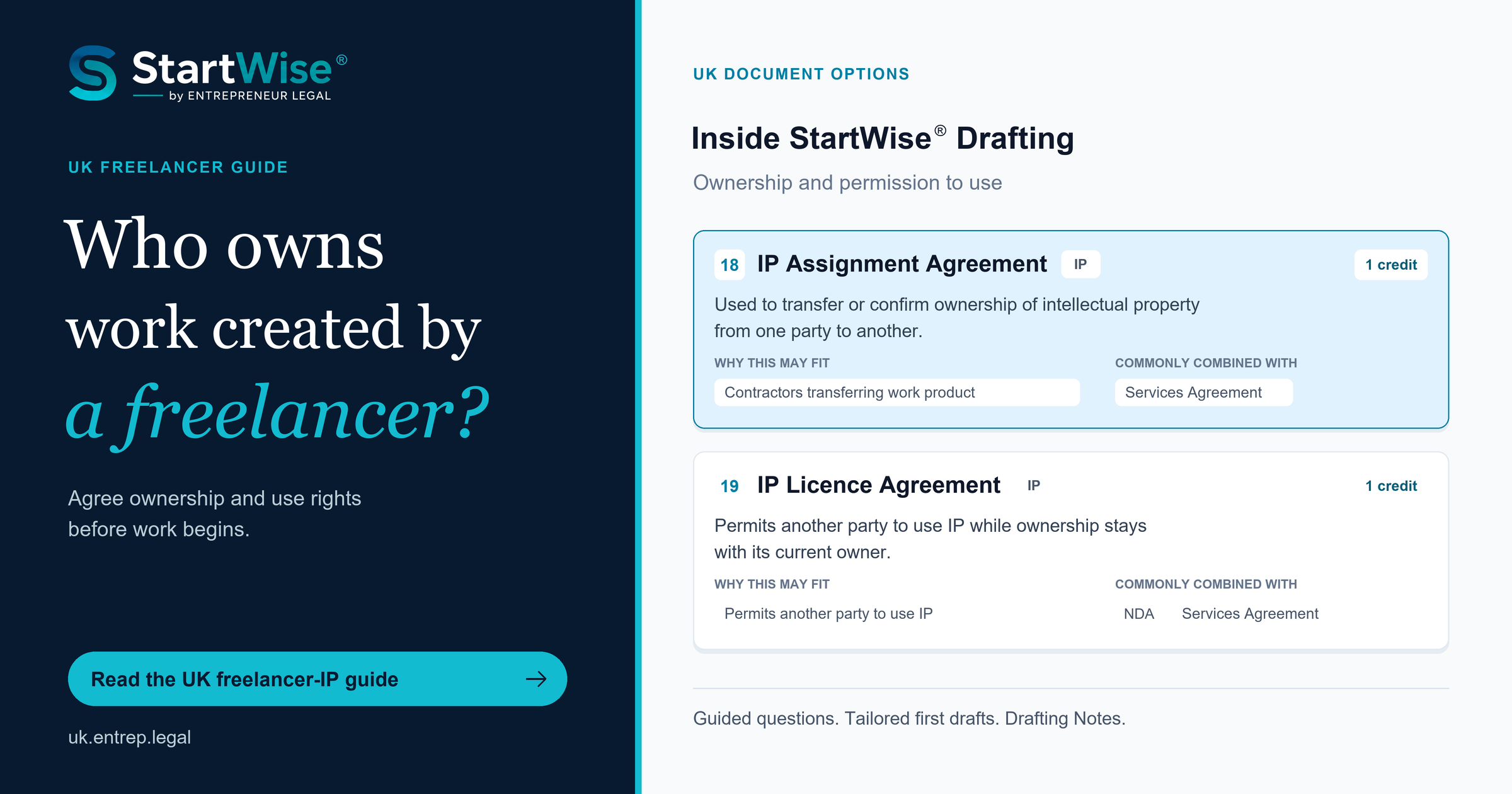
StartWise® currently lists an Independent Contractor Agreement and an IP Assignment Agreement. For a reasonably standard arrangement where the parties understand the relationship, deliverables and intended ownership outcome, StartWise® Drafting asks document-specific guided questions, generates a tailored first draft and provides Drafting Notes that may identify assumptions and completion points. A free account permits exploration; drafting credits are required for document generation. Neither a generated first draft nor its Drafting Notes constitute lawyer review or a legal determination of ownership.
A static download may be an alternative for a clearly defined task. The verified Entrepreneur Legal UK Etsy IP Assignment Agreement (Startups-UK) is aimed at a transfer from an individual to a company; the Content Creation Agreement (UK) is a more specific option for a content commission with ownership/licensing choices. Check that the actual parties and rights fit before using either. For joint or disputed ownership, agency/subcontractor chains, registrable rights, complex licence terms, AI provenance or investor-critical IP, obtain solicitor/IP analysis rather than relying on self-service drafting or a generic assignment.
Static template alternatives, where the facts and parties fit
The verified UK Etsy listings below are secondary to StartWise® guided drafting and do not themselves establish that the assignor owns the rights.
- IP Assignment Agreement (Startups-UK): individual-to-company transfer of identified IP
- Content Creation Agreement (UK): defined content-creation engagements with an appropriate assignment or licence choice
Common mistakes and practical consequences
| Mistake | Practical consequence |
|---|---|
| Assuming payment transfers copyright | The company may have paid for an asset it can use but does not own, creating diligence and sale risk. |
| Using “all IP” language without checking third-party assets | The assignment may promise rights the freelancer cannot transfer. |
| Relying on an implied licence | The licence may be narrower than later product, sublicensing or sale plans require. |
| Ignoring design rights | A product/design asset may sit under a different ownership regime from the copyright analysis. |
| Ignoring AI/tool provenance | The company may not know what rights exist, what can be transferred or what tool restrictions apply. |
Frequently asked questions
Does paying a freelancer mean I own the copyright?
No. Payment and ownership are separate questions. Commissioned copyright will usually remain with the creator unless ownership is changed by agreement.
Can a freelancer assign copyright in a contractor agreement?
Yes, if the assignment satisfies the relevant statutory formalities and the agreement actually captures the relevant rights.
Can future work be assigned before it exists?
UK copyright law permits future copyright to be dealt with prospectively in a signed agreement in appropriate circumstances.
What if there was no IP clause?
The company may have an implied licence depending on the facts, but that is not the same as ownership and the scope can be uncertain.
Do the same rules apply to freelance designers?
Not necessarily. Copyright and design rights are separate and design ownership rules should be checked independently.
What if an agency used freelancers or subcontractors?
Check the rights obtained by every creator and the chain of transfer or licensing to the agency and onward to your company. The agency’s signature alone may be insufficient if it never acquired the relevant IP.
Author, legal review and update information
Author / reviewer: By Gabriel C. Mbanefo — Solicitor of the Senior Courts of England and Wales; Director & CEO, Entrepreneur Legal UK. Author profile: https://uk.entrep.legal/about/. Legal/editorial approval: to be confirmed before publication (do not imply final approval is already given).
Planned publication date: 17 November 2026.
Current source-check date: 14 November 2026 (focused legal and product source research; see source-check register).
Jurisdiction statement: General UK information with England and Wales private-law assumptions where relevant. Not legal advice.
Sources and related Entrepreneur Legal resources
- Contractor Agreement UK: Clauses, Status, IP and Payment
- What Legal Documents Does a UK Startup Need? (2026 Guide)
- Hiring Employees and Contractors — Entrepreneur Legal UK
- Protecting Your Business Name, Logo and IP — Entrepreneur Legal UK
- CDPA 1988, ss. 9–11, 87, 90–91 and 215 (first ownership, joint works, moral rights, assignment and designs)
- Intellectual Property Office — Ownership of copyright works
- Intellectual Property Office — A quick guide to protecting your creative work (11 November 2026)
- Government — Report on Copyright and Artificial Intelligence (18 March 2026)
- Intellectual Property Office — Proposed designs reforms (4 November 2026)
- Explore StartWise® Drafting
- Verified Etsy UK IP Assignment Agreement (Startups-UK)
- Verified Etsy UK Content Creation Agreement
- About the author — Gabriel C. Mbanefo
Choose the right next step
Draft through StartWise. Review for less.
Explore the current guided UK documents, or contact Entrepreneur Legal UK where your matter requires review, consultation or bespoke support.