Entrepreneur Legal UK · Insight
UK Founder Agreement Checklist: Equity, Vesting, Leavers and IP
By Gabriel C. Mbanefo — Solicitor of the Senior Courts of England and Wales; Director & CEO, Entrepreneur Legal UK.
Founder agreement at a glance
| At-a-glance question | Practical answer |
|---|---|
| Who is this for? | Two or more founders of a UK private company who want to record roles, ownership expectations, governance, founder departures, IP and future funding arrangements. |
| When does it arise? | Ideally before substantial value, IP or investor expectations build up; also when founder roles, equity, commitment or governance materially change. |
| Is a Founders’ Agreement legally required? | There is no general rule requiring every UK startup to use a document with this title. It is usually commercially advisable, but separate company-law actions and records may be legally required to implement share and governance arrangements. |
| Routine drafting route | StartWise® Founders’ Agreement where the founders have made the core commercial decisions and the arrangement is reasonably standard. |
| Get legal/tax advice first when | Vesting or reverse vesting, restricted founder shares, section 431 elections, buy-backs, unusual share rights, bespoke articles, investment, pre-incorporation arrangements, tax or a founder dispute are involved. |
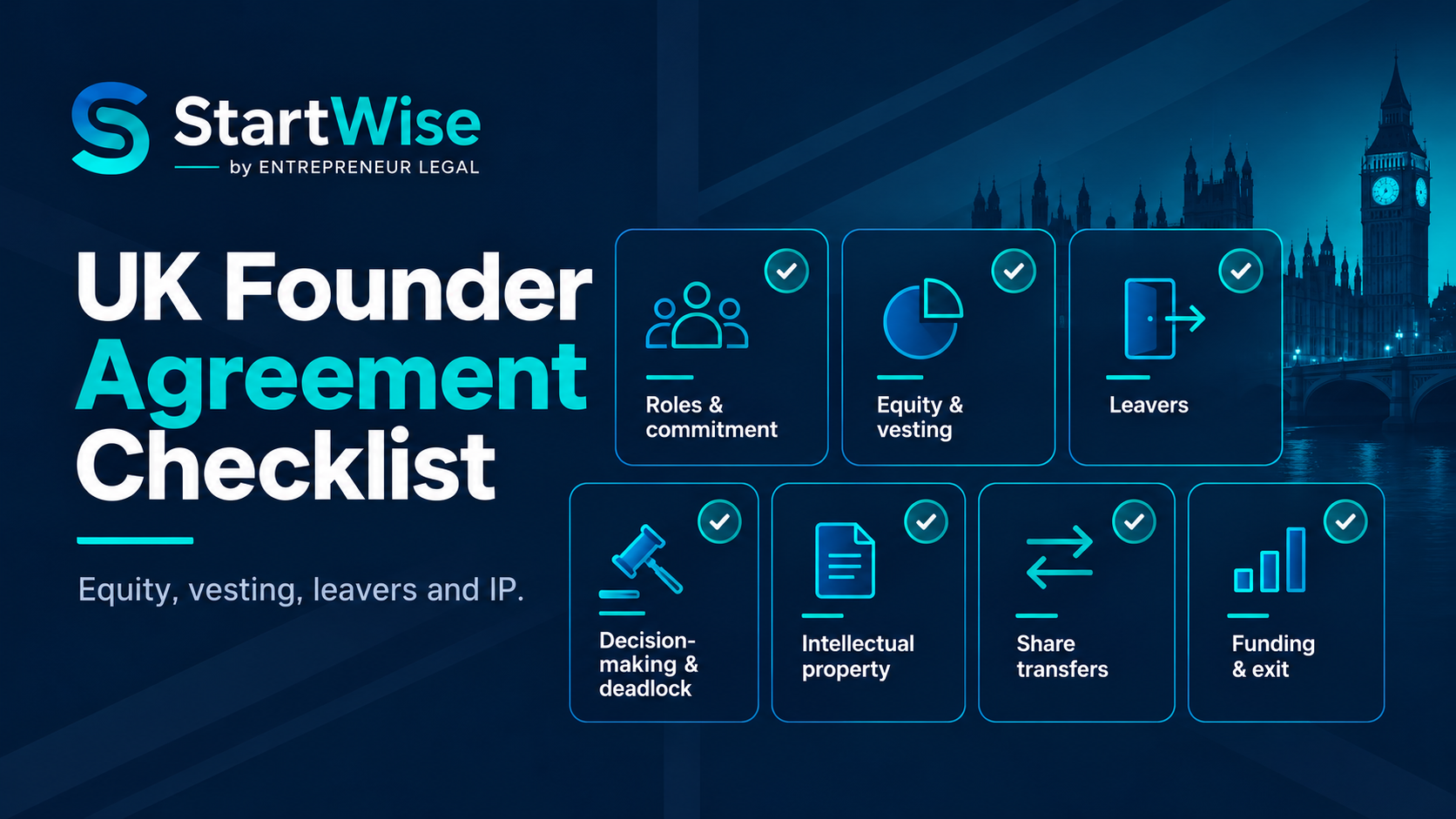
UK founder agreement checklist: 12 decisions to resolve
| Decision | Founder questions to resolve | Why it matters |
|---|---|---|
| Founder roles and time | Who is full-time? What is each founder accountable for? What happens if commitment changes? | Prevents equity expectations drifting away from contribution. |
| Equity expectations | What does each founder hold now, and what is expected later? | Avoids treating an informal percentage discussion as completed company-law implementation. |
| Vesting / reverse vesting | Should equity be earned over time? What happens on early departure? | Addresses the risk of a departing founder retaining a disproportionate stake. |
| Decision-making | Which matters are day-to-day, majority, unanimous or reserved? | Separates operational authority from fundamental founder consent. |
| Deadlock | What happens if founders cannot agree on a reserved matter? | Creates a process before a dispute freezes the company. |
| Leavers | How are departure scenarios defined and what economic consequences follow? | Departure rules can materially affect value and ownership. |
| Share transfers | Can a founder sell or transfer shares? Do others have pre-emption or consent rights? | Protects the ownership group from unexpected changes. |
| IP and confidentiality | Has founder-created IP been properly transferred/licensed to the company? | Investor and buyer diligence often focuses on ownership chain. |
| Pay and expenses | When do salaries start and which expenses are reimbursed? | Avoids informal expectations becoming disputes. |
| Outside interests | Can founders run other businesses or take side work? | Helps manage conflicts, time and competition. |
| Funding and dilution | How will founders approach investment, new shares and dilution? | Early assumptions can change when outside capital arrives. |
| Exit and sale | What happens if the company is sold or a founder wants to exit? | Aligns expectations before there is a transaction. |
How to use this checklist
Use each item as both a founder decision and an implementation check. The founders’ agreement records the private bargain, but share ownership, company records, tax elections, IP assignments and constitutional changes may sit outside the agreement and still need separate action.
1. Confirm the ownership baseline before discussing vesting
Start with the company’s actual register of members, cap table, share classes and articles. Separate shares already issued from shares merely promised or expected. A founders’ agreement can record obligations, but it does not by itself allot or transfer shares; corporate authority, pre-emption rights, transfer documents, statutory records and filings may also be relevant.
2. Separate founder roles from shareholder rights
Record each founder’s role, expected time commitment, decision authority and outside interests. Then distinguish those operational arrangements from board powers and shareholder-reserved matters. A 50/50 economic split does not itself resolve authority, deadlock or who may bind the company.
3. Decide vesting, leaver and tax outcomes together
If equity is subject to vesting or reverse vesting, decide the economic outcome and the legal mechanism together: who acquires unvested shares, at what price, under which approvals and what happens if the founder does not cooperate. Founder shares can also be employment-related securities. Where restricted securities are involved, a section 431 election may be relevant and HMRC normally requires the election within 14 days of acquisition. Company buy-backs engage separate Companies Act 2006 Part 18 requirements.
4. Trace pre-incorporation IP and contracts
Identify code, designs, content, inventions, domains and other assets created before incorporation and check who owns them now. Copyright assignments generally need signed writing. Also check contracts purportedly made for the company before it existed: Companies Act 2006 section 51 can leave the person who acted for the unformed company personally bound unless the arrangement was structured otherwise. A post-incorporation assignment, novation or new agreement may be needed.
5. Align the checklist with the articles, funding plans and future exits
Check transfer restrictions, pre-emption, reserved matters, leaver provisions and exit mechanics against the articles and any later shareholders’ or investment agreement. New founders, an option pool, outside investment or new share classes can make the original founder agreement obsolete, so the documents should be reviewed as the ownership structure changes.
Common founder-agreement mistakes
| Common mistake | Practical consequence |
|---|---|
| Treating a 50/50 promise as completed share ownership | The private agreement and the company’s actual register/cap table can diverge. |
| Using vesting language without implementation mechanics | A leaver clause may not actually deliver the intended share transfer or buy-back outcome. |
| Ignoring ERS tax and section 431 timing | A founder may miss a short tax-election window or create an avoidable tax issue. |
| Assuming the founders’ agreement overrides the articles | Transfer, voting or governance provisions can conflict with the company’s constitution. |
| Assuming founder-created IP automatically belongs to the company | Investor/buyer diligence may expose gaps in the company’s chain of title. |
| Using a company buy-back as if it were a simple contractual transfer | Part 18 company-law procedures and funding/payment requirements can be engaged. |
| Leaving pre-incorporation arrangements undocumented | The company may not own or be bound by what founders assumed was transferred before it existed. |
| Never updating the arrangement after funding or a new founder joins | The document can cease to match the cap table, articles and investor rights. |
Choosing the drafting route
If the founders understand their commercial choices and need to record a reasonably standard arrangement, StartWise® Drafting can guide them through document-specific questions and generate a tailored first draft of a Founders’ Agreement. Drafting Notes can draw attention to assumptions or implementation points that may need confirmation.
Prefer a static downloadable template? If the founders have already identified the correct document, made the key commercial decisions and are comfortable adapting the wording themselves, an Entrepreneur Legal UK Founders’ Agreement template is also available on Etsy. This is a self-service option rather than a guided drafting route: unlike StartWise®, the template does not take the user through document-specific questions to generate a tailored first draft.
Legal and, where appropriate, tax advice should come first where founders are still deciding the equity structure; implementing restricted founder shares or reverse vesting; considering a section 431 election; using company buy-back mechanics; changing the articles; dealing with pre-incorporation IP; preparing for investment; resolving a founder dispute; or handling a complex departure.
Create a free StartWise® account to explore available documents. Drafting credits are required when you are ready to generate a document.
Documents and information to gather before drafting
- Current cap table, register of members and share-class details.
- Current articles of association and any shareholders’ or investment agreement already in force.
- Founder roles, expected time commitment, decision authority, pay/expenses and outside interests.
- Current shares already issued and any future or conditional equity expectations.
- Proposed vesting/reverse-vesting schedule, leaver categories, transfer price and intended buyer or purchase mechanism.
- Any valuation, employment-related securities, section 431 election or ERS reporting questions requiring tax input.
- Evidence of founder-created IP, including code repositories, design files, domains, assignments and contractor agreements.
- Any pre-incorporation collaboration, IP, customer or supplier arrangements that may need assignment, novation or replacement.
- Funding plans, option pool proposals, new share classes, expected investors and likely replacement governance documents.
- Any existing disagreement, founder departure or cross-border issue that should be resolved before self-service drafting.
Red flags: get legal or tax advice before relying on a standard draft
- Founder shares are restricted, vest over time or may be forfeited, particularly where a section 431 election may be relevant.
- The company itself is expected to buy back a leaver’s shares or unusual share classes/rights are involved.
- The founders have not yet agreed the cap table, valuation, voting rights or economic effect of a departure.
- IP was created or contracted for before incorporation and ownership has not been formally transferred to the company.
- The articles need amendment, investors are joining, or the arrangement must interact with a shareholders’ agreement or subscription documents.
- There is already a founder dispute, a contested departure or a cross-border tax/company-law issue.
FAQs
Is a founders’ agreement legally required in the UK?
There is no general rule requiring every UK startup to have a document with that title. It is a contractual tool used to record founder arrangements. Separate company-law documents and actions may still be required.
Is a founders’ agreement the same as a shareholders’ agreement?
They can overlap, but they are not automatically the same. A founder agreement often focuses on the early founder relationship, while a shareholders’ agreement may govern a wider shareholder group and later investment structure. The company’s articles remain important in both cases.
Can the agreement give a founder shares?
It can record obligations and expectations, but actual share issuance, transfer or buy-back can require corporate steps and should be implemented correctly. The private agreement should match the cap table, statutory records and any required filings.
Should founders use vesting?
Vesting can address the risk of a founder leaving early with a large stake, but the right mechanism depends on the company, current ownership, tax position and intended economic outcome. Material arrangements should be legally and tax reviewed.
When is StartWise® appropriate?
StartWise® can help founders who have made the key commercial decisions and want a guided first draft of an available Founders’ Agreement. It should not replace legal advice on complex equity, tax, investment, buy-back or company-law implementation.
Are founder shares automatically outside employment-related securities tax rules?
No. HMRC states that there is no special exemption just because shares are described as founders’ shares. A founder who is or will be a director can acquire employment-related securities. Restricted shares, valuation, the price paid, reporting and any section 431 election should be considered early with tax/legal advice where material.
What if the founders agreed terms before the company was incorporated?
Check the implementation after incorporation. A pre-incorporation contract does not automatically bind the later company, and founder-created IP or other rights may need a separate assignment or other post-incorporation step so that the company and its records match the intended arrangement.
Author, review date and jurisdiction
Author / reviewer: Gabriel C. Mbanefo — Solicitor of the Senior Courts of England and Wales; Director & CEO, Entrepreneur Legal UK.
Publication date: 6 October 2026.
Last substantive legal review: 18 September 2026.
Jurisdiction statement: General information for founders of UK private companies limited by shares, using an England-and-Wales contractual framework. Companies Act 2006 company-law points are UK-wide; tax, contract, employment, dispute and cross-border issues can require different analysis. Not legal advice.
Sources and related Entrepreneur Legal resources
- Primary authority: Companies Act 2006, including sections 17 and 33 (constitution), section 51 (pre-incorporation contracts), section 113 (register of members), Part 17 (share capital/allotment and pre-emption) and Part 18 (company purchases of own shares).
- Primary authority: Copyright, Designs and Patents Act 1988, sections 11 and 90.
- Primary authority: Income Tax (Earnings and Pensions) Act 2003, Part 7, including sections 421B and 431.
- Official tax guidance: HMRC Employment Related Securities Manual, ERSM20240 (founders’ shares) and ERSM30450/30460 (section 431 election timing).
- Official company guidance: Companies House, changes to company registers and share-structure guidance.
- StartWise® UK Access.
- What Legal Documents Does a UK Startup Need?
- Business Formation and Business Structure.
- Entrepreneur Legal UK Founders’ Agreement template on Etsy.
- Author profile: Gabriel C. Mbanefo / Entrepreneur Legal UK.
Important information
StartWise® Drafting is not legal advice, lawyer review, legal approval or legal sign-off. Creating an account, purchasing drafting credits or generating a document does not by itself create a lawyer-client relationship. Entrepreneur Legal UK is the trading name of Entrepreneur Legal Ltd. Entrepreneur Legal Ltd is not regulated by the Solicitors Regulation Authority and does not carry on reserved legal activities. Where legal services are performed by solicitors, those solicitors are individually authorised and regulated by the Solicitors Regulation Authority.
Choose the right next step
Draft through StartWise. Review for less.
Explore the current guided UK documents, or contact Entrepreneur Legal UK where your matter requires review, consultation or bespoke support.