Entrepreneur Legal UK · Insight
UK Legal Document Template vs AI vs Guided Drafting: Which Should You Use?
By Gabriel C. Mbanefo - Solicitor of the Senior Courts of England and Wales; Director & CEO, Entrepreneur Legal UK.
The important distinction is not simply template versus AI. It is how much legal and commercial judgement the user must supply before, during and after drafting, and how visible the remaining assumptions are. A polished document can still be the wrong document, omit an important issue or use wording that does not fit the real transaction.
Which route fits how much you already know?
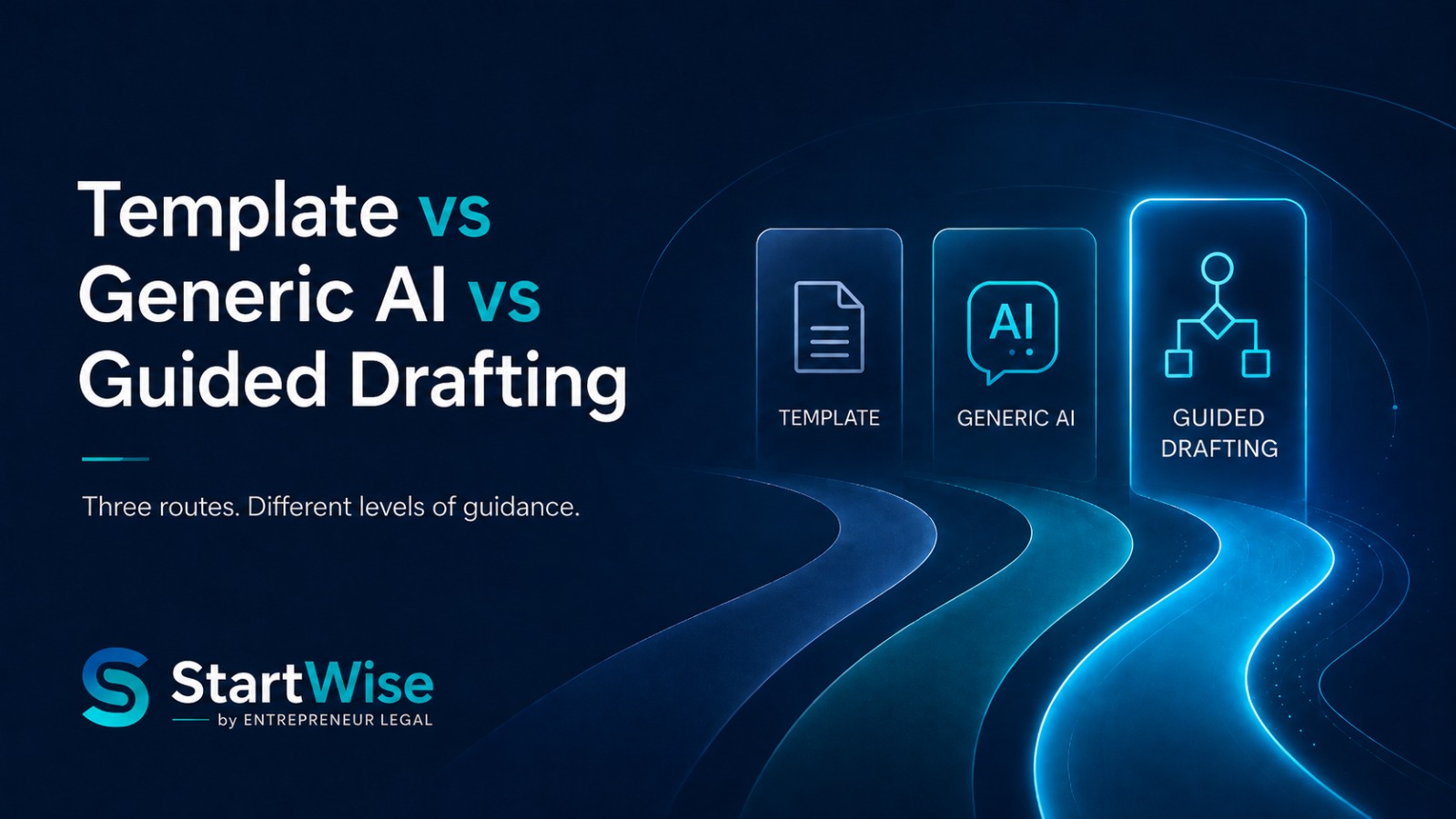
Imagine a founder who has just agreed to bring in a developer to build the first version of a product. They search for a contractor agreement. At that point, three self-service routes may all appear sensible: download a contractor template, ask a general AI chatbot to draft one, or use a guided drafting process built around a contractor agreement.
All three can produce a draft. That is not the same as producing a document that fits the commercial relationship. The founder still needs to address matters such as deliverables, payment, confidentiality, intellectual property, termination and the actual status of the working relationship. The route they choose changes how much of that decision-making is left to them.
At a glance: template vs AI vs guided drafting vs legal support
| Route | What it does well | What the user still needs to know | Best fit |
|---|---|---|---|
| Downloadable template | Immediate structure and standard wording. | Choosing the correct document, adapting it, spotting hidden assumptions and checking execution. | Routine situations where the user already understands the document and is comfortable adapting it. |
| General AI chatbot | Fast, flexible drafting, explanation and revision in response to prompts. | Framing the problem, supplying context, spotting omissions, checking jurisdiction and independently verifying the output. | Users who can accurately instruct the tool and independently check the legal and factual output. |
| Guided drafting | Document-specific questions before drafting, a tailored first draft and Drafting Notes that make assumptions and follow-up points more visible. | Accurate answers, commercial choices, checking that the available document fits, responding to Drafting Notes and deciding when advice is needed. | Often the most structured self-service route for a routine need that closely matches an available document. |
| Legal support | Matter-specific legal judgement, advice and negotiation support within the agreed scope. | Complete and accurate facts and commercial instructions still need to be provided. | Complex, bespoke, sensitive, regulated, cross-border, disputed, heavily negotiated or high-value matters. |
1. When a legal document template can be the right tool
Templates are not inherently poor legal tools. Many business documents follow recognisable structures, and a well-drafted template can be a useful starting point. The problem arises when the user treats the template as the legal answer rather than the starting material.
A template usually assumes that you can identify the correct document, understand the placeholders and options, and recognise provisions that do not fit. That may be realistic for a founder who has used the same kind of agreement repeatedly. It may be much less realistic for someone who is signing their first commercial contract or dealing with a new legal issue.
A template is often a practical route where the transaction is genuinely standard, the parties are not negotiating unusual risk allocation, the user understands the commercial terms and there are no obvious regulatory or cross-border complications. It becomes less attractive as the number of assumptions increases.
2. What general AI changes, and what it does not
General generative AI removes much of the blank-page problem. A user can describe a relationship and receive a draft quickly. It can also help explain clauses, suggest alternative wording and reorganise information. That flexibility can be useful.
With an open-ended general AI tool, however, the user typically bears much of the burden of framing the problem, supplying the relevant facts and deciding what needs to be checked. A model may ask useful follow-up questions, but that does not guarantee that every legally relevant issue will be surfaced. If the user asks for the wrong agreement or omits important context, the output can still look convincing. A non-lawyer may also have difficulty detecting an inaccurate legal proposition.
This is not a theoretical concern. On 17 August 2026, the Solicitors Regulation Authority published a warning notice for solicitors and law firms highlighting inaccurate AI-generated legal material, including fictitious cases or citations, and confidentiality risks when client information is entered into AI systems without appropriate safeguards. The warning is directed at regulated legal professionals rather than founders using AI for their own business documents, but the underlying point is relevant: plausible output still requires verification.
The UK Government's AI Playbook similarly describes hallucinations as outputs that appear truthful but are false and warns against treating generative AI as automatically reliable for factual content. For business drafting, speed and fluency should not be confused with legal accuracy or suitability.
3. What guided drafting adds: structure, context and visible assumptions
Guided drafting does not eliminate judgement. Its purpose is to reduce the amount of document architecture and information-gathering that the user has to design for themselves, while making important assumptions and follow-up points easier to see. For a routine matter that closely fits an available document, that can make guided drafting a particularly attractive self-service starting point.
Instead of beginning with a blank prompt, the user chooses the document they need and answers structured questions about that agreement, policy or relationship. Their answers and reusable business information can then feed into the first draft. The key difference is the structure of the process: the user is not being asked to design the legal-document interview from scratch, and the output can retain a clearer connection to the assumptions and choices that produced it.
StartWise™ Drafting follows this model. In its UK early-access environment, StartWise guides users through document-specific questions and can reuse business-profile information when generating a tailored first draft. It also generates Drafting Notes alongside the draft to highlight assumptions, points to confirm, practical completion steps and issues that may justify legal review. A basic account can be created and the available documents explored without purchasing a drafting credit; a credit is required when the user is ready to generate a document. StartWise Drafting is not legal advice, lawyer review, legal approval or legal sign-off.
Why do Drafting Notes matter?
A clean legal document can create false confidence if the user cannot see which assumptions sit behind the wording. Drafting Notes are designed to make some of that unfinished thinking visible.
Depending on the document and the answers provided, they can identify an assumption used in the draft, ask the business to confirm a commercial choice, flag an implementation point or indicate that legal review may be sensible.
For example, a Refund and Cancellation Policy draft may state that it assumes a 14-day refund rule, ask the business to confirm when that period should run, raise the treatment of platform or payment fees, highlight how statutory cancellation rights will be presented at checkout and recommend lawyer review where the consumer-facing marketplace model creates additional risk. The benefit is not that the notes guarantee every issue has been found. It is that the draft is less likely to present unresolved assumptions as if they were settled facts.
For many routine matters, this gives guided drafting a practical advantage over the other self-service routes. A static template usually leaves its assumptions embedded in standard wording. A general AI response can explain or critique its own output if prompted, but the user still needs to know which questions to ask and what to verify. StartWise combines structured questions, a tailored first draft and Drafting Notes that make points still needing attention easier to identify.
4. Guided drafting does not mean automatically suitable
Guided drafting is most useful when an available document closely matches the user's need. Drafting Notes can improve transparency, but they do not make an unsuitable document suitable and should not be treated as a complete legal issue list. The user remains responsible for supplying accurate information, making the commercial choices presented during drafting, responding to points raised in the notes and seeking advice where the underlying issue requires legal judgement.
A founder negotiating an unusual exclusivity arrangement, a business operating in a heavily regulated sector, a company in an active dispute or a cross-border transaction involving competing laws may need advice that a self-service drafting process is not designed to provide.
How should you choose between a template, AI, guided drafting and legal support?
| Question | If yes | Likely route |
|---|---|---|
| Do you already know the exact document and the provisions you need? | You may not need much guidance on structure. | A suitable template may be sufficient if the situation is standard. |
| Can you accurately prompt and independently verify AI legal drafting? | You can take on more of the instruction and checking burden. | General AI may assist, but verify material legal and factual content before relying on it. |
| Is there a current StartWise document that closely matches a routine business need? | Structured questions can reduce guesswork, while Drafting Notes can make assumptions and follow-up points more visible. | Guided drafting through StartWise is often a strong self-service starting point when the available document closely fits the need. |
| Is the matter heavily negotiated, disputed, regulated, unusual or high-value? | The consequences of getting the legal analysis wrong are greater. | Consider a legal consultation, review or bespoke support. |
| Are you unsure which jurisdiction, agreement or legal route applies? | The uncertainty exists before drafting begins. | Consider legal advice before relying on a self-service drafting route. |
Four mistakes to avoid whichever drafting route you use
- Choosing the wrong document. A beautifully drafted NDA will not solve a contractor IP ownership problem if the real issue requires an IP assignment or contractor agreement.
- Treating labels as facts. Calling someone an 'independent contractor' does not determine their legal or tax status. The real working relationship and working practices matter.
- Ignoring execution and implementation. A document that is never signed, never followed or never updated when the underlying arrangement changes can create false confidence.
- Assuming the document removes the need for advice. Drafting and legal advice solve different problems. A document can capture agreed terms; advice is needed where the user must understand rights, obligations, legal exposure or strategy in their specific circumstances.
How do the three self-service routes differ in practice?
A marketing agency wants to hire a freelance designer for a six-month client project. The commercial deal is straightforward: a fixed monthly fee, defined deliverables, confidentiality and transfer of project IP.
With a template, the agency finds a contractor agreement and edits it. This may work if the founder recognises which clauses need attention. With general AI, the founder explains the arrangement and asks for a UK contractor agreement. The draft may be more tailored, but the founder still has to decide what to request and what to check. With guided drafting, the founder chooses the relevant contractor document and is asked structured questions about the parties, services, fees, deliverables, IP, confidentiality and termination before the first draft is generated. Where relevant, Drafting Notes can then make assumptions or follow-up points visible rather than leaving the founder to infer them from the contract wording alone.
If the reality is more complicated, for example the designer works fixed hours, is subject to close control and is integrated into the agency's team, the drafting route is no longer the only question. Those factors may raise employment-status and tax issues, but no single factor is conclusive. At that point, the founder should not treat any drafting tool as a substitute for advice on the underlying relationship.
When should you move beyond self-service drafting?
The more legal judgement the matter requires, the weaker the case for treating document creation as a purely self-service exercise. Consider separate legal support where the matter involves a material equity position, significant investment, unusual liability, regulated activity, cross-border issues, a threatened dispute, complex tax or employment-status questions, or substantial negotiation between parties with competing interests.
Explore more practical founder guidance in Entrepreneur Legal UK Insights or review the current StartWise documents before choosing your drafting route.
FAQs
Is a legal document template legally valid in the UK?
A document is not valid or invalid merely because it began as a template. Its legal effect depends on factors including the type of document, its terms, the parties, the surrounding facts and any applicable formation or execution requirements. A template can be a useful starting point, but it does not guarantee suitability or enforceability.
Is it legal to use AI to draft a contract in the UK?
There is no general UK prohibition on a business using AI as a drafting aid for its own contracts. That does not mean the output is automatically suitable or enforceable. Accuracy, confidentiality, personal-data handling, intellectual-property issues, the terms of the AI service and any legal or regulatory requirements relevant to the transaction still need to be considered. Where the uncertainty is legal rather than editorial, professional advice may be appropriate.
Is guided drafting the same as legal advice?
No. A guided drafting process can structure document-specific questions, use the user's answers to create a first draft and surface assumptions or follow-up points through Drafting Notes. That does not by itself amount to lawyer review, legal approval, legal sign-off or matter-specific legal advice.
What are StartWise Drafting Notes?
StartWise Drafting Notes are explanatory notes generated alongside the draft. They can identify assumptions used in the document, points the business should confirm, practical completion issues and circumstances in which legal review may be sensible. They are intended to make the drafting process more transparent, not to provide a complete legal analysis or guarantee that every issue has been identified.
Can AI hallucinate clauses or legal rules?
Generative AI can produce inaccurate or invented factual and legal material that appears plausible. The SRA's August 2026 warning notice highlights this risk in legal work. Material legal propositions generated by a general AI system should be checked against reliable sources before they are relied upon.
When is a downloadable template enough?
A template may be suitable when the situation is genuinely routine, you know the correct document, understand the choices within it and can check that the wording fits the transaction. If you are unsure about those points, guided drafting or legal support may be more appropriate.
When should I use a lawyer instead of a drafting tool?
Consider legal support when the matter is high-value, unusual, regulated, cross-border, heavily negotiated, disputed or legally uncertain, or when the consequences of choosing the wrong approach are significant.
Can I explore StartWise before buying a document?
Yes. The current StartWise UK offering allows users to create a free account, complete a business profile and explore the available documents. Drafting credits are required when the user is ready to generate a tailored first draft.
Author, jurisdiction and review information
Author: Gabriel C. Mbanefo — Solicitor of the Senior Courts of England and Wales; Director & CEO, Entrepreneur Legal UK.
Jurisdiction discussed: England and Wales.
Content owner: Entrepreneur Legal UK. Legal and product review: Gabriel C. Mbanefo.
Last substantive review: 25 August 2026. Review again after a material legal, regulatory, StartWise feature, availability or pricing change, and otherwise at least every six months.
Official sources and related Entrepreneur Legal resources
- StartWise UK Access — current product features, document availability and review pricing.
- SRA warning notice: Misuse of AI — published 17 August 2026.
- UK Government Artificial Intelligence Playbook — hallucinations and generative-AI limitations.
- GOV.UK employment status guidance.
- UK Startup Legal Documents Guide.
- Founder Agreement Guide.
- UK Insights.
- Contact Entrepreneur Legal UK.
Disclaimer
General information only. This article does not constitute legal advice.
StartWise Drafting is not legal advice, lawyer review, legal approval or legal sign-off. Lawyer review, legal consultations and bespoke legal services are separate services and are provided only where expressly agreed. Creating a StartWise account, using StartWise Drafting, purchasing drafting credits or generating a document does not by itself create a lawyer-client relationship.
Entrepreneur Legal UK is the trading name of Entrepreneur Legal Ltd. Entrepreneur Legal Ltd is not regulated by the Solicitors Regulation Authority and does not carry on reserved legal activities.
Choose the right next step
Draft through StartWise. Review for less.
Explore the current guided UK workflows, or contact Entrepreneur Legal UK where your matter requires review, consultation or bespoke support.