Entrepreneur Legal UK · Insight
Loan Agreement UK: What Should Business Lending Terms Cover?
By Gabriel C. Mbanefo — Solicitor of the Senior Courts of England and Wales; Director, Entrepreneur Legal Ltd (Entrepreneur Legal UK).
At a glance: loan document versus legal workstream
| Issue | What the agreement can do | What may sit outside it |
|---|---|---|
| Principal / interest / repayment | Record commercial debt terms and payment mechanics. | Tax/accounting consequences and any regulatory rules. |
| Regulatory perimeter | Record facts/declarations where appropriate. | Whether lending is regulated or exempt; permissions; mortgage/credit-broking analysis. |
| Security | Covenant to provide security and coordinate it. | Separate debenture/charge/mortgage and perfection/registration. |
| Guarantee | Record or reference guarantee obligations. | Personal exposure, enforceability and independent-advice issues where relevant. |
| Priority | Record subordination if properly structured. | Existing lender consents, intercreditor/deed of priority, security priority. |
| Conversion to equity | Not a routine debt-only clause in many cases. | Investment/securities, company-law, tax and fundraising analysis. |
Step one: classify the lending before drafting it
FCA rules do not reduce to “business loan = unregulated”. Article 60C(3) of the Financial Services and Markets Act 2000 (Regulated Activities) Order 2001 provides a business-purpose exemption for credit exceeding £25,000 where the agreement is wholly or predominantly for a business carried on, or intended to be carried on, by the borrower. This is more than a size test: borrower type, purpose, activities and any property security must be examined.
Article 60C(5) permits a qualifying business-purpose declaration to create a presumption, but it must comply with FCA CONC App 1.4 and the presumption does not apply if the lender or its agent knew or had reasonable cause to suspect the declaration was inaccurate (article 60C(6)). A declaration does not turn an otherwise regulated loan into an exempt one. Loans to limited companies are assessed differently from credit to individuals, sole traders or certain partnerships; a mortgage or other regulated activity may call for a separate perimeter assessment.
Core terms to settle before the document is generated
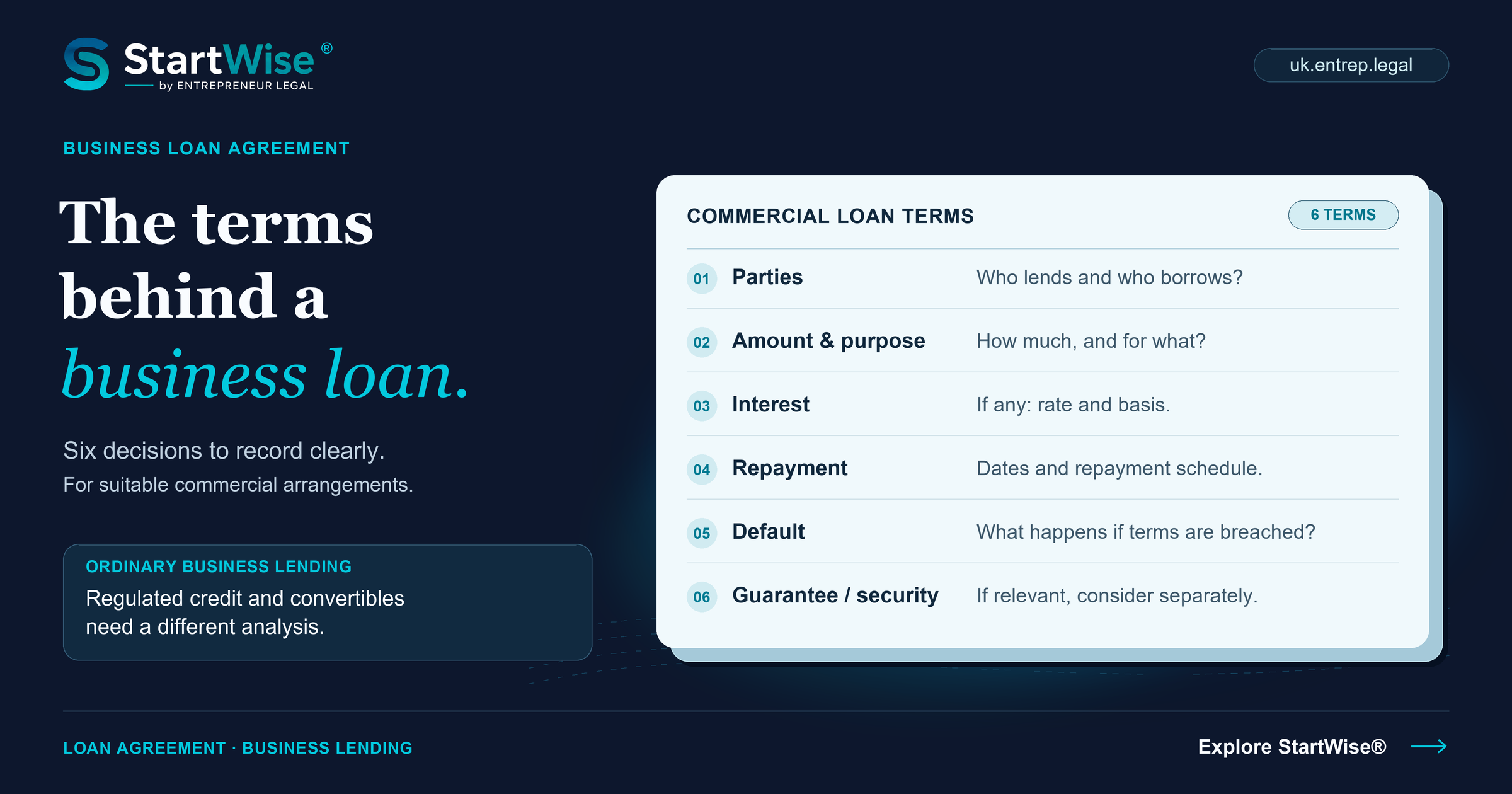
1. Parties, principal and drawdown
Identify the correct legal entities and amount. State whether funds are advanced once or in tranches, any conditions precedent, the availability period and permitted purpose. If money has already been advanced, draft to the actual facts.
2. Interest, fees and calculation
State whether interest is fixed/floating, the rate or benchmark, accrual basis, payment dates, compounding (if any), default interest and fees. “5% interest” is incomplete unless the calculation mechanics are clear.
3. Repayment and prepayment
Set maturity, instalments, voluntary prepayment rights, any premium/break cost and the difference between a payment grace period and a default cure period.
4. Representations and covenants
Use proportionate assurances and ongoing obligations. A connected founder loan should not automatically copy an institutional venture-debt covenant package.
5. Events of default and remedies
Define triggers, materiality, cure periods and acceleration. The agreement should make clear when sums become immediately due and what remedies follow.
Security is a separate legal step
Calling a loan “secured” does not create or perfect a valid security package. The parties may need a separate charge, debenture, mortgage or other document and any applicable perfection or priority steps. For a registrable charge created by a UK company, Companies Act 2006 section 859A generally permits 21 days beginning the day after creation for Companies House delivery; late registration normally requires a court order.
Under section 859H, a charge not registered within the applicable period is void, insofar as it confers security over company assets, against a liquidator, administrator and creditors. The underlying obligation to repay survives, and the money secured becomes immediately payable under section 859H(4). Those effects are distinct from contractual events of default and cannot be repaired merely by rewriting the loan terms.
Guarantees create separate personal exposure
A founder or director who guarantees a company loan assumes a personal obligation. In England and Wales, section 4 of the Statute of Frauds 1677 generally requires a promise to answer for another person’s debt to be evidenced in writing and signed by the person charged or someone lawfully authorised. The scope, cap, continuing-security wording, indemnity language, variations and release conditions all matter.
A primary indemnity may require separate analysis; not every clause labelled a guarantee has identical legal characteristics. Independent legal advice is not automatically compulsory for every commercial guarantee, but it can be important in particular circumstances, especially where the signatory may not understand the exposure.
Existing finance can control what the startup is allowed to do
Bank debt, venture debt, investor documents or earlier shareholder loans may restrict additional borrowing, security or payments. A new loan agreement cannot determine priority against every other creditor by itself. Consents, subordination, a deed of priority or intercreditor arrangements may be needed.
Director and shareholder loans need the correct direction and approvals
A director lending personal funds to their company is different from a company lending money to a director. The former is commonly documented as a company borrowing, with commercial, accounting, conflict and interest-payment considerations. A company loan to a director or a director of its holding company generally requires members’ approval under Companies Act 2006 section 197 unless an exception applies; section 207 includes an exception for relevant minor transactions up to an aggregate £10,000.
Connected persons, quasi-loans, guarantees and security may engage other provisions, so do not assume a general Loan Agreement addresses them. Check the company’s constitution, board decisions and member approvals as well as the loan terms.
Governing law is not a cosmetic choice
The UK contains distinct legal systems. Contract, security, insolvency and enforcement can differ across England and Wales, Scotland and Northern Ireland. Avoid drafting a generic “UK law” clause where a specific system should be selected.
Interest, connected-party tax and financial distress require separate review
Tax treatment should be checked before agreeing interest, withholding, release or repayment terms. HMRC explains that where a director lends to their company, the company normally does not pay Corporation Tax on the loan principal, while interest can be the director’s taxable income and may require the company to deduct basic-rate Income Tax and report it through CT61.
Loans from the company to a director or shareholder can have different corporation-tax and benefit-in-kind implications. A distressed company should also consider directors’ duties, creditor interests, existing restrictions and the risk that some transactions, security or repayments may later be challenged in insolvency. These are fact-specific questions for accountants or legal advisers, not matters decided by a standard agreement.
Where StartWise® Drafting fits
The public UK StartWise® document library lists Loan Agreement as available. For a reasonably standard business loan with identified parties, amount, repayment structure and confirmed regulatory position, StartWise® Drafting asks guided questions and generates a tailored first draft. Drafting Notes can flag assumptions and completion points, but they are not a legal opinion and do not certify the transaction or the document.
StartWise does not decide whether the lender needs FCA permission, create or perfect a security package, register a charge, advise on tax/insolvency, document a convertible investment or resolve intercreditor priority. Those issues should be analysed first.
Choosing between StartWise®, an Etsy template and legal support
For an ordinary, understood loan without regulatory, security, guarantee, corporate-approval or material tax uncertainty, StartWise® Drafting is the primary guided route for preparing a Loan Agreement first draft. Where someone instead wants a static Word/PDF template, Entrepreneur Legal UK also offers the “Loan Agreement (UK) (with Drafting Tips and Instructions)” on Etsy: Loan Agreement (UK) with Drafting Tips and Instructions. Check the specific transaction and listing scope before using it.
The listing mentions security and guarantees, but purchasing a template does not itself create or perfect security, establish a valid guarantee, obtain FCA authorisation or give legal advice. For complex or unclear transactions, see Entrepreneur Legal UK Debt Finance and Raising Finance for separate legal support.
Common mistakes and practical consequences
| Mistake | Practical consequence |
|---|---|
| Assuming £25,000+ automatically means “unregulated” | The arrangement may still fall within another regulated regime or fail the exemption conditions. |
| Writing “secured” without separate security documents | The lender may not have the asset rights/priority it expected. |
| Missing the company-charge filing window | Security can become vulnerable in insolvency and late registration may require court relief. |
| Treating a personal guarantee as boilerplate | A founder may take uncapped or continuing personal exposure without appreciating it. |
| Ignoring existing finance documents | The new borrowing/security may breach covenants or rank differently from what the parties assumed. |
| Treating a company-to-director loan as routine company borrowing | Potential section 197 member-approval, governance and tax issues may be overlooked. |
| Assuming a loan template creates security or validates a guarantee | Separate instruments, written guarantee formalities and perfection may be required. |
| Ignoring interest withholding or impending insolvency | Tax reporting or creditor-related issues may arise despite clear repayment wording. |
Frequently asked questions
Is every business loan required to be in a long written agreement?
No, but undocumented lending creates serious evidential and enforcement risk, and some regulated/security contexts have formal requirements.
Does borrowing more than £25,000 automatically make the loan unregulated?
No. Amount is only part of the relevant exemption/perimeter analysis.
What is the difference between the loan and security?
The loan creates the repayment obligation. Security gives asset-backed rights and generally requires separate documentation/perfection.
Does a company charge need to be filed?
Companies House guidance says a charge created by a company generally must be registered within the statutory 21-day period.
What if the loan converts into shares?
That is not simply a repayment clause. Company-law, fundraising, securities and tax issues may arise and should be analysed before using a routine loan document.
Does a company loan to its director need approval?
Often yes. Companies Act 2006 section 197 generally requires member approval for a company loan to a director, subject to exceptions including certain minor transactions. A director advancing money to the company is a different transaction.
Is a personal guarantee included automatically in a Loan Agreement?
No. A guarantee is a separate personal commitment requiring proper drafting and, in England and Wales, satisfaction of the applicable signed-writing rule. Neither a general loan clause nor an Etsy template automatically verifies its validity or suitability.
Author, legal review and update information
Author / reviewer: Gabriel C. Mbanefo — Solicitor of the Senior Courts of England and Wales; Director, Entrepreneur Legal Ltd (Entrepreneur Legal UK). Author profile: https://uk.entrep.legal/about/. Final author/editorial approval to be confirmed before publication; the source check is not a claim of personal sign-off.
Planned publication date: 24 November 2026.
Current source-check date: 14 November 2026: targeted check of official legislation, FCA CONC, Companies House guidance, HMRC, StartWise® UK availability and exact Etsy listing.
Jurisdiction statement: General UK business-lending information with England and Wales contract assumptions; security/enforcement rules differ elsewhere in the UK. Not legal advice.
Sources and related Entrepreneur Legal resources
- Entrepreneur Legal UK: Debt Finance.
- Entrepreneur Legal UK: Raising Finance.
- Entrepreneur Legal UK: Commercial Agreements.
- StartWise® UK Access.
- Entrepreneur Legal UK Loan Agreement Etsy template.
- FSMA 2000 (Regulated Activities) Order 2001, article 60C.
- FCA CONC Appendix 1.4 — business-purpose declaration requirements.
- Companies Act 2006, section 197 and section 207 — director loans and exceptions.
Choose the right next step
Draft through StartWise. Review for less.
Explore the current guided UK documents, or contact Entrepreneur Legal UK where your matter requires review, consultation or bespoke support.